Crawlspace Insulation Replacement in Bellingham — When Rodent Damage Justifies It
Rodent Shield Bellingham · Crawlspace insulation removal and replacement after Norway rat infestation in Bellingham WA. Contaminated batt removal, enzyme sanitation, vapor barrier restoration, and new insulation installation. Free inspection.
Book Your Free Inspection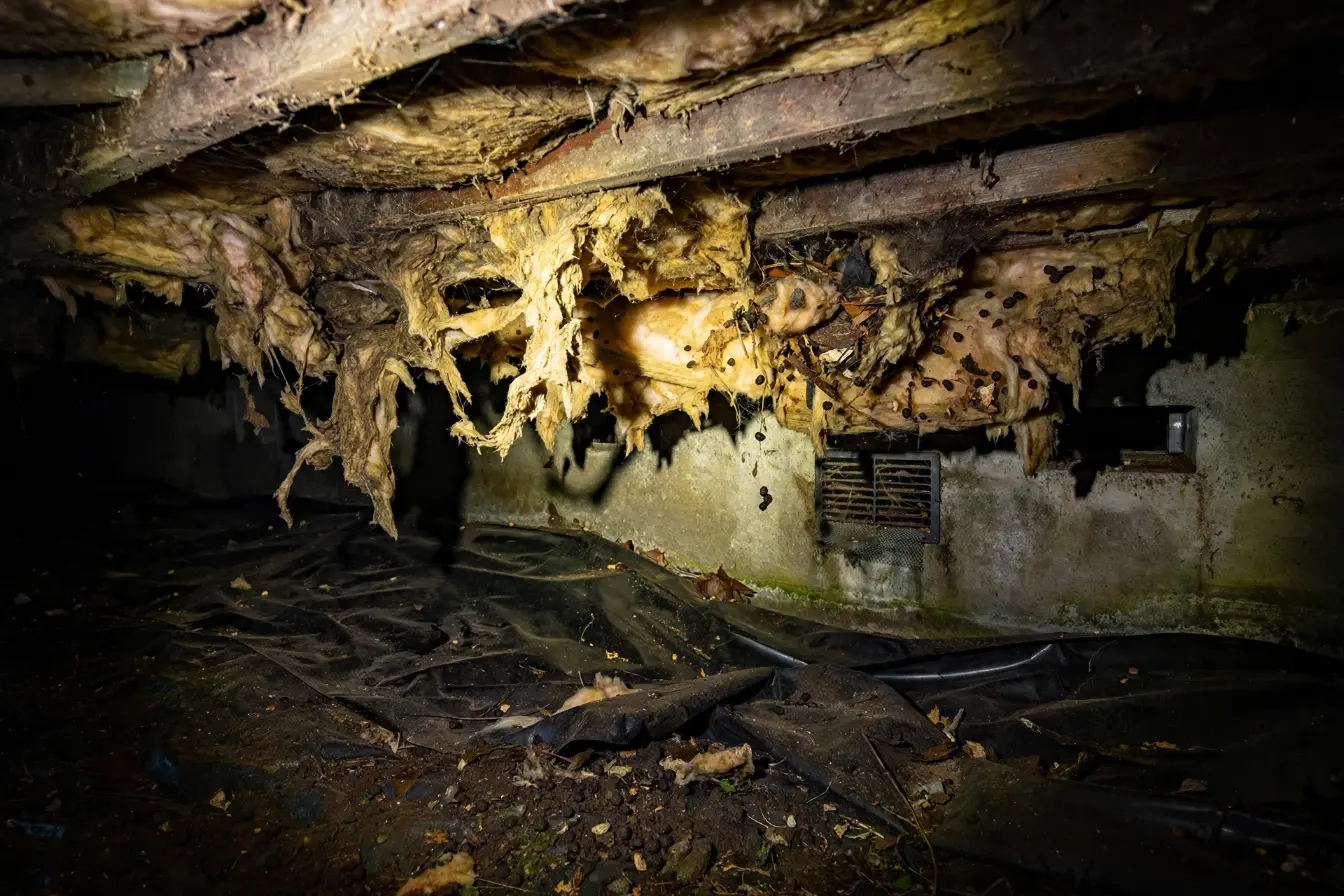
Norway rat infestation in a Bellingham crawlspace is rarely a short-term event. A colony that establishes in the fall, following Whatcom Creek flooding that displaces their burrows, nests in crawlspace insulation batts through winter, saturating the material with urine and depositing droppings throughout. By the time the infestation is discovered in spring, the insulation has been contaminated beyond remediation.
Crawlspace insulation replacement is the most significant job scope in residential rodent control. It’s also the most commonly misunderstood, homeowners often think contaminated insulation can be cleaned in place, or that the odor will fade on its own. Neither is true in the situations we encounter in Whatcom County crawlspaces.
When Crawlspace Insulation Must Be Replaced
Not every crawlspace with rodent activity requires insulation replacement. The threshold is contamination level:
Replacement required: Visible urine staining on batt material, droppings throughout the batt layer (not just along one runway edge), visible nesting material consolidated in insulation batts, or insulation that is compressed to less than half its original thickness from rodent traffic and nesting.
Targeted removal may be adequate: Droppings concentrated in one runway area with the surrounding insulation intact and dry, limited to the access area near a single entry point with no evidence of nesting in the main crawlspace body.
For most Columbia, Lettered Streets, and Birchwood homes where Norway rats have been active for a full winter or longer, full insulation replacement is the appropriate scope.
Why Leaving Contaminated Insulation Is a Problem
The scent trail argument: Norway rat urine contains chemical markers that signal safe territory to other rodents. Even after the active colony is removed and the entry points are sealed, contaminated insulation retains these chemical markers for months. If any entry point is missed or fails, new rats entering the crawlspace go directly to the contaminated zone, the chemical invitation still works.
The HVAC argument: Crawlspace insulation in contact with or near floor registers and flex-duct connections is a direct contamination pathway. Every furnace cycle moves air past the contaminated material and distributes particulate through the home. The musty smell Bellingham homeowners notice when the heat runs in fall is frequently airborne contamination from saturated crawlspace insulation.
The health argument: Norway rat urine can contain leptospirosis bacteria. Urine-saturated insulation in a Bellingham crawlspace with any HVAC exposure is an ongoing health risk, not just an odor problem.
The Complete Replacement Process
Step 1, Exclusion first: We don’t remove insulation until the home is sealed. Removing contaminated insulation from an unsealed home exposes the replacement material to re-contamination within weeks.
Step 2, Contaminated material removal: All contaminated insulation batts removed in sealed bags. HEPA vacuum cleanup of debris in the crawlspace floor and along structural members.
Step 3, Enzyme sanitation: Crawlspace structural surfaces, floor joists, subfloor sheathing, sill plates, vapor barrier, treated with enzyme-based deodorizer. Let dwell and air-dry before new insulation is installed.
Step 4, Vapor barrier assessment: If the vapor barrier is damaged (Norway rats move through and under vapor barriers extensively), it’s repaired or replaced as part of the scope. A functioning vapor barrier is part of the moisture management that prevents conditions that attract rodents in the first place.
Step 5, New insulation installation: R-19 kraft-faced fiberglass batts for standard Bellingham crawlspaces (the standard minimum for existing homes in Whatcom County). Installed with vapor barrier facing up toward the warm side. Secured to floor joists per manufacturer installation guidelines.
Cost of Crawlspace Insulation Replacement in Bellingham
Free inspection to assess contamination scope. Small crawlspace (under 600 sq ft): $800–$1,500. Medium crawlspace (600–1,000 sq ft): $1,200–$2,200. Large crawlspace (1,000–1,600 sq ft): $2,000–$3,500. Full remediation including exclusion, vapor barrier, and insulation: $2,500–$5,000 for most single-story Bellingham homes.
Frequently Asked Questions
Can contaminated crawlspace insulation be cleaned rather than replaced?
No. Urine saturation is not surface contamination, it penetrates the batt material throughout. Enzyme sprays applied to the surface of installed batts cannot reach the urine that has wicked into the batt center. Replacement is the only approach that produces a clean starting point.
Does homeowner’s insurance cover crawlspace insulation replacement after rodents?
Standard policies exclude pest damage as a maintenance issue. Some supplemental endorsements cover certain types of sudden damage. Call your insurer and ask specifically about rodent-damaged insulation, the answer varies by policy. We provide written damage assessment reports for insurance documentation purposes.
How long does crawlspace insulation replacement take?
One to two days for most Bellingham single-story homes. Larger crawlspaces or complex access situations may require a third day.
Do you offer insulation work separately from rodent control?
Yes. If you’ve already completed exclusion with another company and need insulation replacement only, we provide that service. The inspection confirms whether exclusion is complete before we install new material.
Ready for a Rodent-Free Home?
Free crawlspace assessment. We’ll tell you honestly whether replacement is needed.
Book Your Free Inspection