How Rodent Shield Bellingham Handles a Rodent Problem, Step by Step
Inspection first. Findings explained. Options priced before work. Then removal, exclusion, cleanup where needed, and follow-up.
Book Your Free Inspection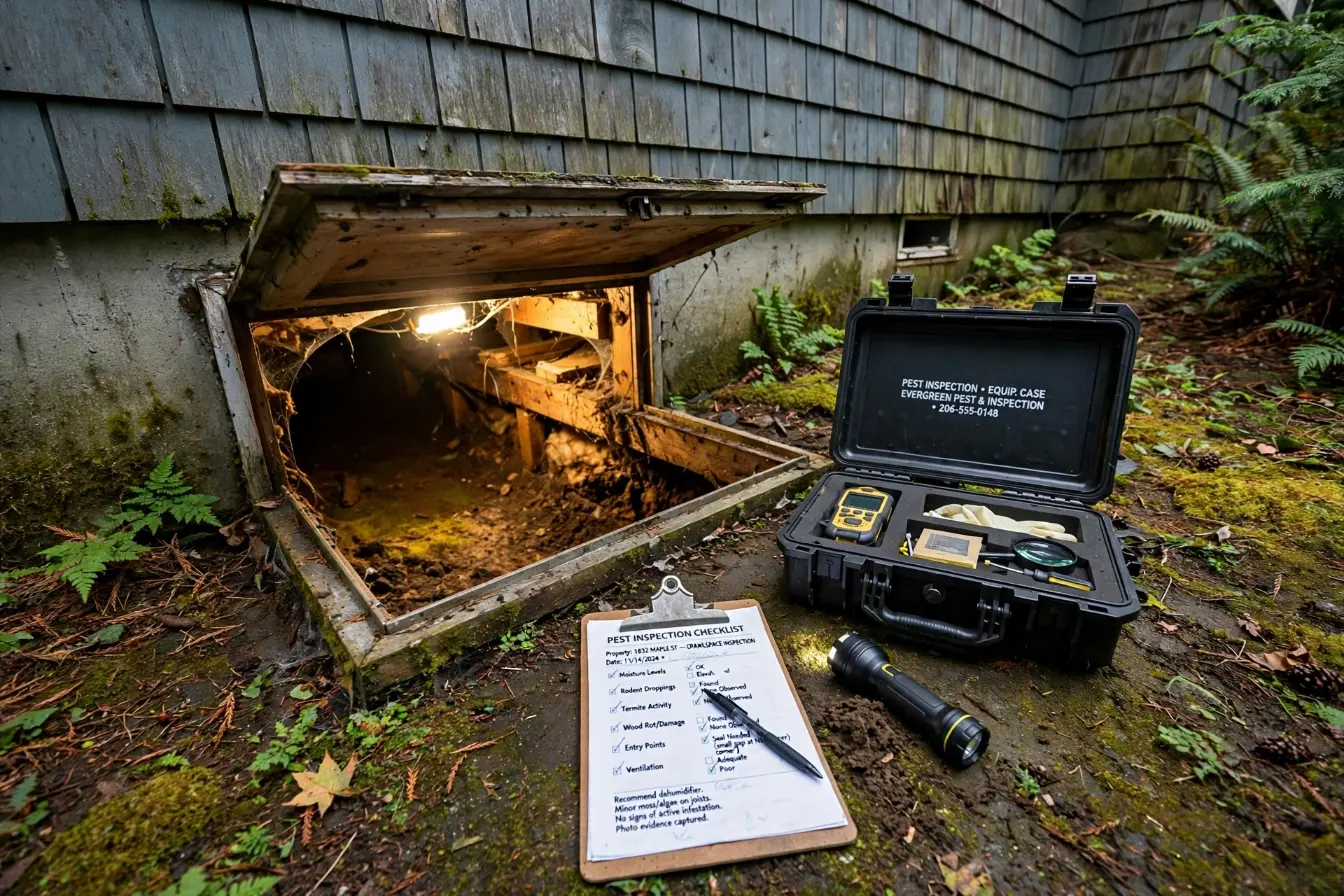
The call data and customer reviews point to the same first question: "Can someone come out, tell me what is going on, and explain what I actually need?"
That is the point of the Rodent Shield Bellingham process. The inspection comes before the recommendation. The findings come before the estimate. And the estimate should tell you what is included, what is optional, and what happens if activity continues after the first visit.
Step 1: Phone Triage (5 Minutes, No Sales Pitch)
When you call, we ask four questions: What are you hearing or seeing, and where? How long has the problem been going on? Are there pets or young children in the home? Is there crawlspace or attic access?
That information tells us what species is likely involved, what inspection areas are the priority, and how urgent the situation is. We confirm your address, note the neighborhood, because Fairhaven and Columbia present different inspection requirements than Sehome or Birchwood, and schedule the inspection. Same-day or next-day is available across Bellingham and most of Whatcom County.
We do not use the phone call to recommend a treatment plan. That would require us to make assumptions about your specific home that we have no basis for making. Every recommendation comes after the inspection.
Step 2: Full Inspection and Photo Documentation
On-site, we inspect every area where rodents could be living or entering: crawlspace, attic, foundation perimeter, garage, utility penetrations, sill plates, roof eaves, and interior areas where activity has been reported.
Every confirmed or suspected entry point is photographed, GPS-noted, and given a severity rating: A, active use, confirmed rodent runway or entry B, probable use, gap of sufficient size with adjacent evidence C, potential future risk, gap not currently in use but accessible
For older homes in Columbia, the Lettered Streets, and Fairhaven, where settling foundations and original plumbing penetrations create the most complex entry point profiles in the Bellingham market, we pay specific attention to the crawlspace sill plate interface and utility wall penetrations. These are the entry points that generalist pest companies most often miss.
You receive a written inspection report the same day, with photos of every documented entry point and a summary of what we found. The report is yours regardless of whether you proceed with any service.
Step 3: Written Estimate With Your Options Explained
Based on the inspection findings, we present what we found, what it means, and what can be done about it, with a cost for each option.
We distinguish between: removal-only service (trapping, no exclusion), partial exclusion (primary entry points sealed), full home exclusion (every gap quarter-inch or larger), and cleanup and remediation (crawlspace insulation, HVAC assessment, enzyme deodorizer).
We explain what each option accomplishes and what its limitations are. If removal without exclusion is sufficient for your specific situation, we'll tell you. If you need full exclusion to achieve a lasting result, which is the case for most older Bellingham homes, we explain why, in terms of the specific entry points we found, not in general marketing language.
You decide. No pressure, no contract, no recurring charge unless you specifically choose ongoing monitoring.
Step 4: Mechanical Removal (No Poison)
We install snap traps and one-way exclusion devices suited to the confirmed species and the confirmed locations. Roof rat trap placement in a Fairhaven attic, positioned on rafters at entry points and runway intersections, is different from Norway rat trap placement in a Columbia crawlspace. The species identification from Step 2 determines the placement strategy.
No interior rodenticide. No risk to your pets, your children, or the hawks, owls, and bald eagles that nest around Whatcom Falls Park, Lake Whatcom, and Sehome Hill Arboretum, all of which face secondary poisoning risk from rodenticide-exposed animals.
We return to service traps and remove dead rodents on a schedule we confirm at booking. You receive a text notification when your technician is 30 minutes out, and a confirmation after each service visit.
Step 5: Permanent Exclusion and Sealing
Every confirmed entry point, severity A and B from the inspection, is sealed with materials rodents cannot chew through. Galvanized hardware cloth at foundation and sill plate gaps. Copper mesh at utility penetrations. Metal flashing at eave and fascia gaps. Reinforced vent covers at crawlspace vents.
Expanding foam is not used as a primary seal. In Bellingham's climate, high humidity, significant rainfall, temperature cycling, foam compresses, cracks, and loses adhesion within one to two seasons. Norway rats push through deteriorated foam in a matter of hours.
All sealing work is photographed as completed. You receive a photo report of every sealed entry point within 24 hours of completion.
Step 6: Follow-Up, Documentation, and 90-Day Guarantee
Seven-day follow-up inspection: we return to confirm traps are clear, seals are intact, and no new activity is present. If any sealed point has been compromised or if new activity is detected in an area that wasn't sealed, we address it during the follow-up at no additional charge.
Written completion report: emailed within 24 hours of job completion. Includes inspection findings, entry points sealed with photos, trap placement locations, follow-up schedule, and any recommendations for ongoing prevention (vegetation management near the foundation, bird feeder placement, crawlspace vent inspection schedule).
90-day guarantee: if rodent activity returns within 90 days of completed exclusion work, we return and address it at no charge. No fine print. No "that's a different species" exceptions.
What Happens If You Still Hear Rodents After the First Visit?
Continuing activity does not automatically mean the entire plan failed. Your review data includes exactly this concern: traps can be placed in a crawlspace or attic while an animal remains active in a wall void or another part of the structure.
The next step should be based on what changed after the first visit: where the sound is now coming from, whether traps show activity, whether the suspected entry points were addressed, and whether another inspection area needs to be opened up. The important part is that the follow-up path is explained before the customer is left wondering what they paid for.
Frequently Asked Questions About Our Process
What happens if rodents are inside a wall cavity that can't be accessed?
This is one of the most common situations we encounter and one of the most important things to explain before any work begins. Traps placed in a crawlspace or attic cannot catch a rodent that is living inside a wall void, different location, different access, different intervention required. If our inspection indicates wall cavity activity, we explain the options: wait for the animal to emerge into a trap positioned on its runway, or in some cases locate and open the wall cavity. We don't let this situation become a surprise after you've paid for initial trapping. If it's a possibility on your job, we tell you during the inspection.
How quickly can you respond in Bellingham?
Same-day inspections are available in Bellingham, Fairhaven, South Hill, Sehome, Birchwood, and most of Whatcom County when you call before noon. Next-day inspections are available for all calls received after noon. We respond to all inquiries within two hours during business hours, Monday through Saturday.
Do I need to be home for the inspection?
Someone should be home to provide access to the crawlspace hatch, attic access, and to walk through the interior areas where you've noticed activity. For the exterior perimeter inspection, we can proceed without you present if that's not possible, but the interior inspection and the estimate conversation work better in person.
What do I need to do to prepare?
Clear access to your crawlspace hatch. If the hatch is inside a closet or utility room, move stored items away from it. Leave kitchen cabinet doors open so we can inspect behind the base of lower cabinets. Note where you've found droppings and how recently, that information speeds up the inspection and helps us determine whether an active infestation is ongoing or historical.
Will you tell me if I don't need professional service?
Yes. If the inspection shows a single point of entry that has already been closed, no signs of active infestation, and historical evidence that appears to be at least a season old, we'll tell you that, and describe what to monitor for going forward. We do not manufacture a problem to justify a service visit.
Ready for a Rodent-Free Home?
Free inspection. Serving Bellingham and all of Whatcom County.
Book Your Free Inspection