Mouse Control in Bellingham WA — Stop the Activity and the Re-Entry
Rodent Shield Bellingham mouse control in Bellingham WA, permanent exclusion, no poison, no contracts. House mouse and deer mouse removal in Fairhaven, Sehome, Columbia, and all Whatcom County. Free inspection.
Book Your Free Inspection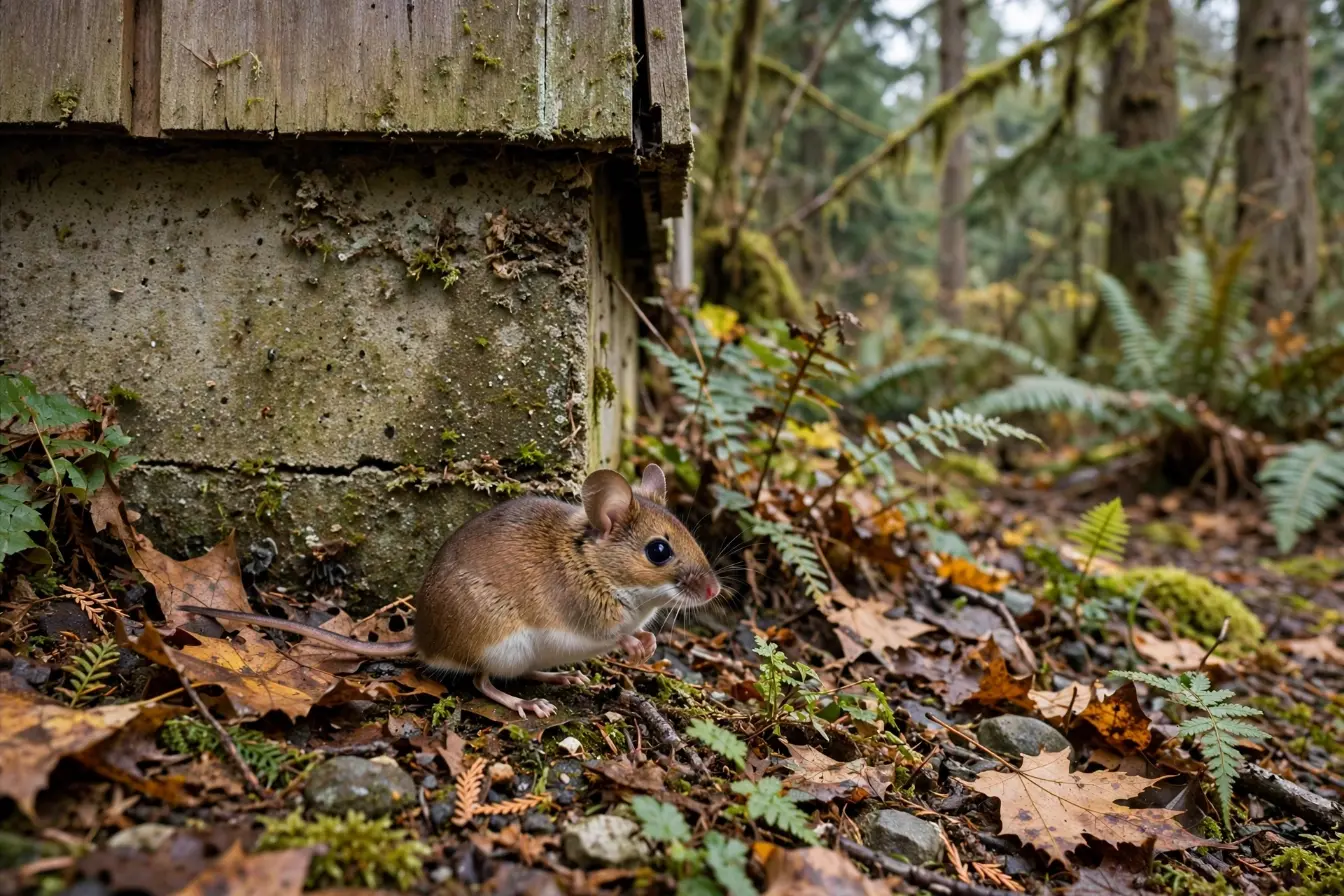
The most common call we get in Bellingham isn't about rats. It's about mice. Someone finds droppings in a kitchen cabinet, hears scratching in the walls at 2am, or opens a cabinet under the sink to find a nest. By that point, the population is already established, because a single pair of house mice produces up to 200 offspring in three months when left undisturbed.
Mouse problems in Bellingham have a specific character. The student rental corridor near Western Washington University, Sehome, Happy Valley, the Lettered Streets, sees the highest house mouse density in the city, driven by high tenant turnover, deferred maintenance, and gaps in older construction that no one has sealed in decades. But mice aren't only a rental problem. They're in South Hill Victorians, in Birchwood split-levels, in Edgemoor homes backed up against wooded lots where deer mice from the forest edge intersect with house mice moving in from the neighboring block.
We serve all of Bellingham and Whatcom County, free inspection, no contracts, no poison.
“I Caught One Mouse. Why Am I Still Hearing More?”
Your real call and review data shows the same pattern repeatedly: homeowners trap one or more mice, but noises or sightings continue. That does not automatically tell you how large the problem is. It tells you the next inspection needs to look beyond the individual animal and check where activity is happening and how mice are still getting access.
Rodent Shield Bellingham separates the problem into three parts: current activity, likely entry points, and the conditions that let the problem continue. That is why why mice keep coming back and rodent exclusion are part of the same mouse-control silo rather than unrelated topics.
Two Mouse Species in Bellingham: The Difference Matters
House Mouse (Mus musculus)
The house mouse is the most common rodent in Bellingham's residential neighborhoods, active year-round in every ZIP code. It weighs barely an ounce, enters through a gap the size of a dime, and establishes a nesting site within 24 hours of entering a structure. What makes it dangerous beyond the property damage, gnawed food packaging, contaminated pantry shelves, chewed wiring in wall voids, is the reproduction rate. One pair becomes a colony in a season. By the time homeowners notice droppings in multiple locations, the population is already past the point where trapping alone will resolve it.
House mice are the dominant pest in Bellingham's rental housing near WWU because they exploit the gaps that deferred maintenance leaves open. A student rental that has housed three tenants in two years, none of whom reported a mouse problem to the landlord, may have mice in the wall voids of every bedroom.
Deer Mouse (Peromyscus maniculatus): The Hantavirus Risk
The deer mouse is a different animal requiring a different response. It's two-toned, brown above, white beneath, with large eyes and large ears compared to the house mouse. It's more common in Bellingham's wooded edges: Edgemoor near Clark's Point preserve, Silver Beach near Lake Whatcom, properties adjacent to Larrabee State Park and Chuckanut Drive.
The critical difference is hantavirus. Deer mice are the primary carrier of Sin Nombre virus, the cause of hantavirus pulmonary syndrome in Washington State. Deer mouse droppings must never be swept or vacuumed dry. The safe protocol, wet the area with a bleach solution first, wear an N95 respirator and gloves, bag and dispose of all material, is not optional when deer mouse activity is confirmed or suspected. We follow CDC hantavirus cleanup protocols on every job where deer mouse involvement is possible.
Why Bellingham Mice Keep Coming Back
The most common question we hear isn't "how do I get rid of mice", it's "why do they keep coming back?" Homeowners who have been setting traps for months, trying peppermint oil, stuffing steel wool in gaps, are genuinely baffled that the problem persists. Here's the honest answer.
Traps catch the mice currently moving through a space. They do not address the entry points those mice used to get in, and they do not eliminate the scent trails that attract new mice from outside. A house mouse establishes a scent trail, a chemical signal from urine and gland secretions, that other mice follow. Even after you've trapped every active animal in the home, incoming mice from outside follow those trails straight back to the same location. Without sealing the entry points and neutralizing the scent trails with enzyme deodorizer, you are running a catch-and-replace program rather than solving the problem.
In Bellingham specifically, peppermint oil lasts 24 to 48 hours in the city's maritime humidity before dispersing. Irish Spring soap washes away in the first rain. Ultrasonic repellers have no peer-reviewed evidence of effectiveness for house mouse control. These products are heavily marketed and it makes sense to try them. They simply don't produce permanent results in Bellingham's conditions.
Mouse Entry Points in Bellingham Homes: What We Actually Find
Fifteen years of rodent inspections in Whatcom County homes produce the same list of entry points, over and over, in roughly this order of frequency:
Sill plate gaps, where the wooden sill plate rests on the foundation wall, settling and shrinkage create gaps that are near-invisible from inside but obvious from beneath the crawlspace. Common in every pre-1940 Bellingham home in Columbia, the Lettered Streets, and Fairhaven.
Utility penetrations, where gas lines, water supply lines, electrical conduit, and cable enter the foundation or exterior wall. Original installation rarely includes a proper rodent-proof seal, and settling widens any gap that was there.
Crawlspace vent screens, original aluminum screens on older Bellingham homes corrode in the maritime climate. A corroded vent screen the size of a palm is an open highway.
Garage door gaps, the bottom seal of most garage doors has a gap when the door meets uneven concrete. House mice do not need much, a gap of a quarter inch is sufficient.
Door sweeps and weatherstripping, original weatherstripping on older Bellingham homes deteriorates. The gap under an aging exterior door is often the first entry point mice use.
Foundation cracks, hairline settling cracks in concrete block foundations, common in Bellingham's older homes, widen to mouse-entry size within a decade.
Mouse Control for Bellingham Rental Properties
Mouse problems in Bellingham's rental housing are a legal issue as well as a pest control issue. Under Washington State's Residential Landlord-Tenant Act (RCW 59.18.060), landlords must maintain rental properties in a condition fit for human habitation, which includes keeping them free from rodent infestation. When a tenant submits written notice of a mouse problem, the clock starts.
For landlords managing properties in the Sehome and Happy Valley corridors near Western Washington University, where house mouse problems are routine between tenant turnovers, we provide inspection reports formatted for property management records, treatment documentation that establishes timeline compliance with RCW 59.18, and between-tenant scheduling that fits cleaning and maintenance crews. No long-term contracts. Documentation for every job.
Frequently Asked Questions: Mouse Control Bellingham WA
How do I know if I have house mice or deer mice in my Bellingham home?
House mice are uniformly gray-brown with a hairless tail roughly the same length as their body. Deer mice are distinctly two-toned, brown or gray above, white on the belly and feet, with a tail that's hairy and bicolored. Deer mice are more likely if your home backs onto wooded green space, if you're near Lake Whatcom or Silver Beach, or if you're adjacent to one of Bellingham's forested park areas. House mice are more likely in older urban neighborhoods and rental properties. If you're not sure which you have, call before attempting any cleanup, the distinction matters because deer mouse droppings require protective handling that house mouse droppings don't.
What is the fastest way to get rid of mice in a Bellingham home?
The fastest path to a permanent solution is: inspection to confirm species and locate entry points, trapping to remove active animals, exclusion to seal every entry point quarter-inch or larger, and enzyme deodorizer to eliminate scent trails. We can typically complete inspection and initial trapping within 24 hours of a first call in Bellingham. Exclusion work follows within the first week. The mistake that slows most homeowners down is starting with trapping before the entry points are found, which means new mice continue entering while you're catching the ones already inside.
Can mice get into my home through the plumbing?
Yes. Norway rats are better known for sewer-line entry, but house mice routinely enter through gaps around water supply pipes and drain lines where they pass through the foundation or floor. In older Bellingham homes where original plumbing penetrations haven't been sealed since installation, these gaps, often behind the vanity under the bathroom sink, or behind the range in the kitchen, are among the most common mouse entry points we find. The gap doesn't need to be large. A quarter-inch opening around a half-inch pipe is enough for a house mouse to enter.
How much does mouse control cost in Bellingham WA?
Inspection is free. Trapping-only service runs $150 to $300. Full exclusion, locating and sealing every mouse entry point, typically costs $400 to $1,800 depending on the home's age and the number of gaps found. Older homes with wood-frame construction near the Lettered Streets and Columbia tend to have more entry points than newer construction in Cordata or Barkley Village. Crawlspace cleanup after mouse contamination adds $400 to $1,200 for a standard Bellingham single-story home.
Will mice go away on their own in Bellingham?
No. House mice do not leave a warm, food-accessible structure voluntarily. They establish territory, build nests, and breed continuously. The population expands until food or space constraints slow growth. In Bellingham's mild climate, there is no cold snap severe enough to stress house mice inside a heated structure. Without intervention, exclusion at minimum, a mouse presence in your home will grow, not resolve itself.
Are the mice in my walls dangerous to my family?
Mouse droppings and urine contaminate food surfaces and can transmit salmonella, leptospirosis, and lymphocytic choriomeningitis virus (LCMV). In homes with young children or immunocompromised family members, droppings in kitchen or pantry areas represent a real health risk. For deer mouse droppings specifically, more common in Bellingham's wooded neighborhoods near Edgemoor and Silver Beach, hantavirus pulmonary syndrome is a serious risk. Never vacuum or sweep mouse droppings dry. Contact us before attempting cleanup if deer mice are involved.
Do you service Bellingham rental properties for mouse control?
Yes, and we work regularly with landlords and property managers across the Sehome, Happy Valley, and Lettered Streets corridors. We provide written inspection reports with photos, treatment documentation for property management records, and scheduling that fits between-tenant timelines. Washington State landlords have specific obligations under RCW 59.18.060, we can help you document compliance.
How do I prepare for a mouse inspection in Bellingham?
Clear access to the crawlspace hatch and attic access if you have one. Move stored items away from the base of garage walls so we can inspect the perimeter. Leave kitchen cabinet doors open and note which areas you've found droppings in, that information speeds up the inspection. You don't need to be home for the exterior inspection, but someone should be present to provide crawlspace and attic access.
Ready for a Rodent-Free Home?
Free inspection. Serving Bellingham and all of Whatcom County.
Book Your Free Inspection